Friday, February 14, 2020

Ten things you can do to show your pets you love them. Happy Valentines Day

Jinxy the dog posing with red roses and a heart for Valentine's Day


Who loves you more than your pet? This Valentine’s Day, don’t forget to show your pets the same love they show you every day.

But how? You already know chocolate is a no-no, and since your pets can’t read e-cards and don’t appreciate jewelry or flowers ― well, that takes all the go-to Valentine’s gifts off the table.
Here’s the good news. There are better ways to show your pets how much you love them, and while you can make Valentine’s Day extra special for them, here are 10 simple things you can do that will make your pet feel loved every day.
1. Feed your pets healthy food.
Just like humans, pets thrive when they have a healthy diet. Unfortunately, there’s a lot of misinformation out there regarding pet food. In fact, many of the studies on canine nutrition are funded by pet food companies ― a situation that poses a conflict of interest. It seems that everyone has a different opinion on optimal nutrition for our furry friends. One reliable source of information, though, is a veterinarian who specializes in nutrition. Visit the website of the American College of Veterinary Nutrition (acvn.org) for some basic guidelines about what to feed your pet, and always check with your vet before changing your pet’s diet.
Matilda the cat eating canned food
2. Exercise your pet.
Exercise is a vital part of enriching your pets’ lives. Walking, running, playing fetch or tug, and learning agility or flyball are all great ways to keep your dog physically fit. For cats, try interactive play with wand toys (we like Da Bird) or balls. Some cats can be taught to enjoy walks outdoors wearing a harness and leash. Many of these activities have the added benefit of exercising humans, too. Always check with your vet before starting your pet on a new exercise regimen.
Alan the cat taking a walk on a harness and leash
3. Learn a new language.
Become bilingual by learning your pet’s language. Our pets are constantly communicating with us through their body language, but sometimes we don’t understand what they’re saying. To learn more, we recommend the books On Talking Terms with Dogs: Calming Signals by Turid Rugaas and Canine Body Language: A Photographic Guide by Brenda Aloff for dogs, and anything by Pam Johnson-Bennett for cats.
4. Pay attention to what he wants to do.
Once you speak dog or cat, start observing whether or not your pets enjoy the activities you’re asking them to participate in. Does your pup indicate through his body language that he really doesn’t enjoy wrestling with other dogs? If so, cut it from your repertoire. On the flip side, try to find things that he loves doing and work those activities into your schedule. For example, if your dog loves to dig, make him a sand pit out of a kiddie pool. If your cat loves going outside, build a cattery so she can enjoy the outdoors safely.
Bunco the dog gets to go on a golf cart ride
5. Invest in a relationship-based training class.
Reward-based training classes help you to build a relationship with your pet, provide her with mental (and sometimes physical) enrichment, and let you just have fun with her. Try a class in basic manners, a Canine Life and Social Skills (CLASS) course or classes to teach your dog nose work, agility, treibball or flyball. Need help finding a good trainer? Check out the resource “Find a Dog Trainer.”
6. Visit the vet for a checkup.
Let’s face it. Few of us like going to the doctor, and our pets are no different. But you can teach your pets to tolerate going to the vet by doling out delicious treats that make the experience more enjoyable. Many clinics will allow you to simply come and visit, so that later on when an appointment is necessary, your pet will have a more positive association with medical care. Don’t forget to schedule your pet’s annual checkup while you’re there.
A cat visiting the Best Friends Animal Clinic
7. Play more games.
Playing games is an effective stress reliever for you and provides your pets with both mental and physical benefits. To keep your pet from getting bored, find a few activities (such as fetch, hide-and-seek and scent games) that you enjoy playing with each other. Your pet isn’t sure how to play games? Ask someone who does reward-based training how you can teach him.
Rive the dog loves playing catch
8. Help him conquer his fears.
In animals, fear manifests itself in several ways, ranging from shutting down to retreating to appearing aggressive. We don’t often work on our pets’ fears (or even notice them) unless it becomes a problem for us. Enhance your pet’s quality of life by vowing to change that this year. If you don’t know where to start, consider hiring a behavior consultant who is certified through the International Association of Animal Behavior Consultants. These professionals can teach you effective techniques for allaying your pet’s fears. You can also get helpful information at bestfriends.org/resources.
9. Use appropriate walking tools.
Collars and harnesses are tools that can help your dog walk on a loose leash and also remain comfortable. If the tool you’re using isn’t meeting your needs and those of your pet, do some research and find something better. For example, front-clip harnesses are ill-advised for running, but they work great for dogs who pull. Back-clip harnesses aren’t recommended for pullers, but work well for dogs who have neck issues. Keep in mind that some walking tools have adverse side effects. Choke chains, for instance, can cause trachea damage even if they’re used correctly. And prong collars often increase aggressive behavior.
10. Enjoy and pamper your pets.
Most important of all, show them just how much they are loved. Take a few extra minutes to cuddle. Let your dog play with his buddies just a bit longer. Give your cat an extra treat now and then just for being cute. Be slow to anger, quick to forgive and cherish every moment you have with your pets this Valentine’s Day.
Give love to homeless pets all year long by becoming a Best Friends member
Lucy and Beth the dogs playing together
Photos by Best Friends staff

Wednesday, February 12, 2020

Understanding Heartworm Disease

source: stone ridge


If there was tagline for heartworm disease, it would be: “It only takes one bite.”
Unfortunately, many pet owners take a risk when it comes to heartworm. In addition, Texas ranks among the top 10 states where heartworm disease is most prevalent. Since heartworm can predispose your pet to life-threatening health issues, prevention is something that should be on the mind of every pet owner.

Understanding Heartworm Disease

Heartworms are thin, spaghetti-like organisms that invade the heart, lungs, and arteries. Although commonly viewed as a canine-specific disease, heartworm can infect cats and other animals. It just happens that domestic dogs and their wild cousins (coyotes) are more susceptible to infection.
Heartworm disease is transmitted through the bite of an infected mosquito. The mosquito transfers tiny parasites, known as microfilariae, to the host animal. As the disease progresses, these microscopic worms develop into larvae, which mature into heartworms. Once grown, adults continue to reproduce and create more microfilariae, sometimes for years if the disease remains undetected.

Symptoms of Heartworm Disease

Clinical symptoms often do not catch the eye of pet owners until the disease is quite severe. Symptoms associated with heartworm can include:
  • Coughing
  • Decreased interest in exercise
  • Lethargy
  • Labored breathing
  • Lack of appetite and weight loss
When left untreated, heartworms can compromise the circulatory and respiratory systems. This can eventually lead to cardiac arrest, liver failure, kidney failure, blood clots, and numerous other emergencies.

Preventing Heartworm in Your Pet

Some owners opt out of parasite preventives hoping to save a little money. However, prevention is far more cost effective (not to mention, safer for your pet). Treating heartworm disease is a complex process that may involve surgery, which would exceed the cost of regular preventives. To assist pet owners, our team always tries to source the best prices on these important monthly medications.
In addition to a monthly preventive, it’s important that your pet be screened and examined each year for heartworm and other parasites. This not only protects your pet, it also protects you and your family from zoonotic diseases (illnesses that can be transmitted to humans).
Other ways to combat pests this spring include:
  • Removing standing water from your yard, including bird baths and plastic pools
  • Avoiding active pest hours, which generally occur around dawn and dusk
  • Checking your pet’s skin daily for fleas and ticks
  • Cutting back tall grasses and weeds  
  • Keeping trash bins in a garage to deter wildlife (which carry parasites)
Although we live in a region rife with mosquitoes, there are ways to protect your pet and keep him or her safe. Please contact us with any questions or concerns.
Source: Stone Ridge

Thursday, February 6, 2020

Exercising with your dog

Source: Earthbath


Are you sticking to your New Year’s Exercise resolution? Most people drop off within the first two months, and it may not be surprising to hear that many people fall of the exercise wagon within the first two WEEKS after nothing but good intentions and fat gym membership fees!
However, if you’re a parent to a slobbery, furry kid, aka a DOG, you have a live-in exercise partner that will help you keep to your daily dose of exercise, in the form of daily walks. 
Interestingly, however, simply having a dog doesn’t automatically correlate with being in shape (shocker!). This is because most people choose pets with a similar activity predisposition to their own, or if pets don’t share their owner’s (low) activity levels to begin with, they often become unwittingly “trained” to live a typically-human sedentary lifestyle. No dog was born to be a couch potato and eat pre-made food regularly dispensed neatly into a bowl!  Some even observe that people choose pets that physically resemble themselves. This means that the overall level of physical activity in a pet ends up correlating to that of their owner, as does their waistline!
One scientific study that looked into the relationship between weight loss (in both people and dogs) and exercising together showed that people who regularly exercised with their dog stuck with their workout plan better than people without dogs. Even celebrities have used their dogs as motivation to lose weight. Remember Nia Vardalos, from My Big Fat Greek Wedding? She said that following the advice of her vet to help Manny, her 6 year old Labrador Retriever, lose weight, also helped her to slim down.  “The two of us lost weight together. The vet had just told us that he was a little bit overweight, so we called it the ‘Manny 6-Lb. Challenge.’ ” She stayed active with daily walks and play time with Manny, which involved chasing a tennis ball.
If you’re just starting out on an “exercise plan” with your dog, or trying to increase your and his activity levels, take it slow. You wouldn’t hit the gym for 3 hours the first day of your membership, would you?  The last thing you want to do is put unnecessary and possibly damaging stress on your dog’s joints and muscles. If your dog has been inactive or is carrying extra weight, just like in humans, high intensity and/or long exercise sessions can be too much for the body and joints, and cause injury.
Start with an evenly paced, low-impact activity, like a short walk or hike, and then begin to increase the length and challenge as you and your dog gets accustomed to the exercise routine. Especially for dogs with joint problems or osteoarthritis proclivities, it’s much healthier to undertake no- or low- impact activities like swimming, paced hiking or walking over high-intensity exercises, like running , jumping, and twisting.
Set attainable and sustainable activity goals for yourself and your pet. If you commit to going on a daily walk, your dog will start to expect it and look forward to it (which will also help to keep you on track!). If you are starting to feel bored with your normal route or type of activity, change it up by trying a new path, or a longer walk. Explore a different park. Drive to a dog-friendly hiking trail. Don’t be afraid to get your paws wet and go for a swim!
And of course, before you start on an exercise program with your dog, make sure you consult with your veterinarian. Dr.Thompson! 

Source: Earthbath

Tuesday, February 4, 2020


Source: Earthbath
Though the “unspoken rules” of dog walking are as common sense to many of us dog owners and dog walkers as knowing what to do with our bottles and cans (recycle please!), or used Kleenex/other trash (garbage!), there are, of course, some people who may be ignorant of or actively choose not to follow the etiquette of dog walking. If one were to ask a “Miss Manners” of the dog world what the “rules” entail, here are five simple tips on dog walking etiquette that will make your neighborhood much more pleasant, for you, your neighbors (some of whom may not be as accepting of dogs and their “lovably quirky” behavior as the typical dog-lover), other dogs, and, of course, your dog:
1) No trespassing! When walking your pet around a residential neighborhood, it is universally accepted as rude if you allow your dog to walk on people’s front lawns, into their gardens, snack on their landscaping, or urinate on their mail boxes, garbage cans, or lawn decorations.  Best to keep him to the sidewalk, street, and encourage him to eliminate on the strip of grass that’s between the sidewalk and street.
2) Pick up the Poo! Obviously, dog walkers should be prepared, under all circumstances, with a plastic bag (or several) for picking up doggy doo… and simply toting them isn’t enough: don’t “forget” to use it! I’ve seen dog walkers make an elaborate show of getting their bag out when another person or car passes by, and then stuffing it away, still empty, as soon as the other person is gone (for shame)! Even if your dog was kind enough not to “go” on a lawn, but instead used the street, sidewalk, city planter, or grass strip between the sidewalk and street, it’s unacceptable to leave the “poo to stew” (or another more colorfully descriptive rhyming phrase… use your imagination)!
3) Your dog might be friendly. But other people might not be. Does your dog want to say hello to everyone that passes, are inspired to jog alongside runners, or chase down roller bladers and bicyclists? Not everyone may be as much of a dog lover as you are, and even if they are, they may be otherwise occupied (trying to beat their personal best time on their daily run won’t happen if they are waylaid by your well-meaning social butterfly of a dog!). If a passerby is interested in your dog, you’ll know it. Best to assume that no one is as interested in your dog as you are (or as your dog is in them), and act accordingly. Some people are afraid of dogs, don’t care for dogs (I know, who ARE these people?!) or simply may not be in the mood to be sniffed, licked, or (worst of all) jumped on. Your objective on a walk should be: keep walking, calmly and purposefully, and not to let your dog run your walk!
4) Other dogs might not be friendly either. Rule #3 also applies to other dogs. Don’t assume that other dog walkers (or dogs) are as interested in socializing their dogs as you (or your dogs) might be. Not all dogs are as happy-go-lucky, social, or calm around other dogs as your perfect Polly is… and I’m sure you wouldn’t want to change that behavior by being the recipient of an aggressive snap or bite from an unsociable dog.  On the converse side of things, if your dog is a “barker,” most people prefer to err on the side of caution and stay away. Best to ask the other owner, particularly if you are going through a puppy socialization stage: “Is your dog friendly? Is it ok if we let our dogs say hi to each other?” and gauge their response, and the dog’s response/behavior when you let the two meet. Make sure you have a tight hold of your leash, and also check to make sure the other dog walker seems in control of his/her dog as well to prevent any unfortunate unpredictable encounters.
5) Best to keep the leash on. Really. Even though you might feel very confident in how “good” your dog is in his ability to walk calmly by your side off-leash and obey all of your verbal commands, his behavior could be unpredictable, depending upon the unexpected (and exciting) nature of a given stimulus (e.g., a darting cat across the street, a tempting squirrel running up a tree, another exciting looking dog, a rushing car, a kid chasing a ball), and the worst thing that could happen while walking a dog is, of course, to lose your dog. Even if you have the utmost confidence in your dog’s off-leash ability, make sure that you acquaint yourself with your city’s leash laws in the area(s) you will be walking. You don’t want to get a ticket, or worse.
As holds true for all parents, pet parents hold a significant amount of responsibility in their hands, and every time you and your pet hit the streets, you both are acting as “ambassador” for dogs, dog owners, and responsible behavior all around. As dog lovers would all agree, the presence of all of the sweet, funny, quirky, silly, wise, protective, placid, loving dogs in our lives all contribute to enriching our neighborhoods and parks, when they listen to Miss Manners, of course. Now… who wants to go for a walk?!
Source: Earthbath


Wednesday, January 29, 2020

Five Common Dog Medications

Friday, January 17, 2020

Household Hazards For Pets


Source: https://www.spca.org/
HOUSEHOLD HAZARDS FOR PETS

There is no way to protect your pet from all potential accidents, but there are a few common danger zones that you can guard against.

WIRES

To avoid electrocution, check all exposed wires and cables for trouble spots such as frayed or trailing wires.  Repair any worn wires and keep them safely out of the reach of your dog or cat.

CHEMICALS

Household cleansers, laundry detergents, bleach, paints, pesticides, fertilizers, anti-freeze, disinfectants and insect sprays are all potentially deadly to household pets.  Make sure all supplies are securely stored in cabinets and any spills are cleaned up immediately.

CHEWING HAZARDS

Do not leave sharp objects around where you dog or cat can chew or swallow them.  Do not allow your pet to play with plastic bags because they can suffocate them.  Keep your shoes and other chewables in closed closets, and make sure your pet has appropriate chew toys to play with. 

POISONOUS PLANTS

English ivy, iris, amaryllis, daffodil and tulip cause gastric irritation and sometimes central nervous system excitement followed by coma and in severe cases death.  Induce vomiting and seek veterinary treatment.
Foxglove, lily of the valley, oleander, monkshood and larkspur can be life-threatening because the cardiovascular system is affected.  The different species of yew are also toxic because they affect the nervous system.  If any of these are ingested, get the dog or cat to a veterinarian immediately.

Wednesday, January 15, 2020

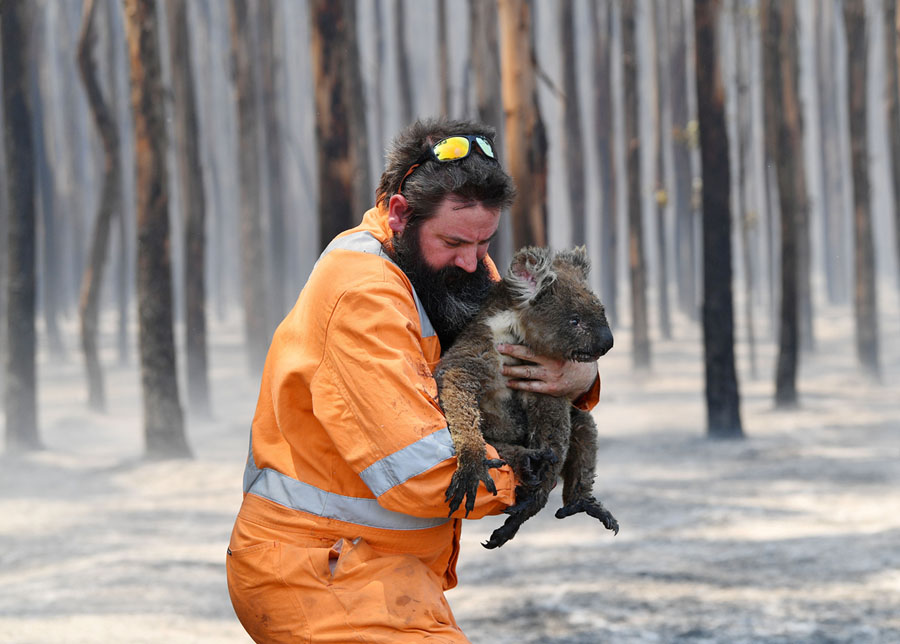
Animals Rescued from the Wildfires in Australia

Source: www.theatlantic.com


Since we are animal lovers ourselves, we could not dismiss the crisis going on in Australia. 

Animals Rescued From Australia’s Bushfires

The horrific wildfires that have been burning across Australia for months now have taken a severe toll on the animals that called the scorched lands home. Estimates of the number of animals killed by the fires range from hundreds of millions to more than 1 billion. Volunteers and crews from Australia’s National Parks and Wildlife Service have been doing what they can to help some of the kangaroos, koalas, lizards, and birds that can be rescued and treated. Ranchers and pet owners have been working to keep the animals in their care secure when possible, but many farm animals have been killed as well. As much as one-third of Australia’s Kangaroo Island has burned so far, with wildlife experts fearing that more than half of the island’s 50,000 koalas have been killed.


Hot for the summer

To avoid these problems and enjoy the  summer season  with your  pet , here're the tips to keep in mind. Provide plenty of water and...