Tuesday, April 23, 2019

Dog Eye Discharge — What’s Normal and What’s Not

Dog Eye Discharge — What’s Normal and What’s Not


Dog eye discharge — whether in the form of dog eye boogers, green eye discharge or something else — can be completely normal... or not. Here's what to know.

Have you ever wondered if your dog’s eye boogers are normal or not? A dog’s eyes can leak and tear for many reasons, some of which are normal and some of which are not. Tear stains are unsightly, but more importantly, dog eye discharge might indicate a problem that requires vet attention.
According to Beth Kimmitt, DVM, resident of ophthalmology at Purdue University’s College of Veterinary Medicine in West Lafayette, Indiana, a dog’s eye is always producing tears, and these tears typically drain at the corners of the eye. “Technically, a normal eye should not have any ocular discharge, but a small amount of clear discharge may be OK,” she tells us. Clear dog eye discharge might look brown and slightly crusty when it dries.
That said, some dog eye discharge is not normal. Read on to find out what’s normal and what needs a vet exam when it comes to dog eye discharge:

This type of dog eye discharge means it’s time to visit the vet.

If your dog has colored green eye discharge, yellow eye discharge or another colored eye discharge, schedule a vet appointment immediately. Other signs of problematic dog eye discharge include squinting, a red-looking eye, or if your dog is rubbing or pawing at his eye. If you think something is wrong with your dog’s eye, don’t wait too long to make that vet appointment — his eyesight could be at risk.

Abnormal eye leakage might signal a dog eye infection or other issues.

“The presence of ocular discharge is a non-specific sign,” Dr. Kimmitt says. “This means that it can be caused by a variety of ocular disorders. Common causes of dog eye discharge include ulcersentropion, keratoconjunctivitis sicca and conjunctivitis (allergic or bacterial).” A corneal ulcer is damage to the cornea, which is the clear membrane that covers the iris and pupil.
Entropion is a condition in which the eyelid rolls inward, causing eyelashes to rub against the cornea. Keratoconjunctivitis sicca (called dry eye) is dryness of the conjunctiva, which is membrane that covers the white part of the eye. Conjunctivitis (sometimes called pink eye) is inflammation of the eye. A vet exam and tests can pinpoint the cause of your dog’s abnormal eye discharge.

Certain breeds are prone to dog eye discharge.

Brachycephalic dog breeds like Pugs and Boxers might have slightly more eye leakage than other breeds due to the combination of a short nose and large, round eyes. In these breeds, some dog eye discharge might be normal, especially if it’s clear, but abnormal dog eye boogers deserve a vet visit.
Poodles and Cocker Spaniels are more prone to blocked tear ducts, too. Usually, these ducts drain the tears from your dog’s eyes out through the nose and back of the throat. With the tear ducts blocked, there’s nowhere for the tears to drain, so they spill over the eye rims and run down the face.

If you see brown tear stains, it doesn’t necessarily mean something is wrong.

“Dogs with white hair coats (like Maltese, Poodles, etc.) might show the discharge easier than other colors,” Dr. Kimmitt says. You can help minimize dog tear stains by wiping the under-eye area frequently and keeping it as dry as possible. You can also try one of the whitening products sold specifically to help with tear stains.

It’s important to keep your dog’s eye area clean.

“A soft, wet cloth can be used to gently wipe away the discharge,” Dr. Kimmitt advises. You can also use a veterinary eye cleaning product to combat dog eye discharge — just make sure it doesn’t contain any alcohol.

Source: Dogster 

What To Do If Your Cat Is Choking


Technically, choking is when something lodges in the larynx or trachea, preventing air flow. This can be nearly anything, even a small object such as a pen cap, bell, or thimble. Fortunately, choking is a rare occurrence in cats.

WHAT TO WATCH FOR


  • Pawing at the mouth, drooling
  • Coughing or gagging
  • Anxiety or panic
  • Labored breathing
  • Fainting, unconsciousness, or, if air flow is completely blocked, an inability to breathe
  • Bad breath, loss of appetite, listlessness (if something has been lodged in the mouth for a while)

PRIMARY CAUSE


Pieces of cat toys like small pompons or bells, splintered bits of bone, and other foreign objects can potentially get stuck in the larynx and cause choking.


IMMEDIATE CARE


If your cat is conscious and not too upset, you can try looking in his mouth for any foreign object. Remove it if you can, but in most cases you will probably not be able to do so safely. However, if your cat is too upset for safe handling, wrap him in a towel or put him in a carrier for transport to the veterinarian.

If your cat is unconscious and not breathing, or breathing with great difficulty, do the following:

  • Open the mouth and pull the tongue forward. If you see a foreign object, try to grab it with your finger or tweezers.
  • If that doesn’t work, try the Heimlich maneuver:

    1. Lay the cat on his side.
    2. Put one hand along his back.
    3. Put the other hand on his belly, just below the ribs.
    4. With the hand on the belly, give several sharp pushes in and up.
    5. Check the mouth for foreign objects and remove them, then close the mouth and give a couple of small breaths through the nose.
    6. Repeat these steps until you are confident there is no foreign object present in the airway.
    7. If the cat is still not breathing after the foreign object has been removed, check for a heartbeat or pulse. If none can be found, begin CPR and/or artificial respiration as needed and take your cat to the veterinarian immediately.

A note about strings: If you find a string (thread, tinsel, etc.) in your cat’s mouth, the temptation is to pull it out. Unless it slides out like a wet spaghetti noodle, DO NOT pull it. It is likely stuck somewhere inside and pulling will only make things a lot worse.


VETERINARY CARE


Diagnosis

Diagnosis will be based on examination of your cat and your description of what happened. X-rays of the head, neck, and chest may be necessary to locate the foreign object. Sedation may be required for the examination and X-rays.

Treatment

Your cat will most likely be sedated or anesthetized in order to remove the foreign object. The removal may be as simple as pulling it out of the mouth, or it may require a complicated surgery on the neck. The foreign object may cause damage that may require suturing or antibiotics, especially if the object has been lodged for a while.

LIVING AND MANAGEMENT


Once the foreign object has been removed, healing usually proceeds without a problem. If there was severe damage from the object, or if surgery was required, laryngeal paralysis is a possible complication. Scarring could cause strictures (narrowing of a passageway) to form, which could make breathing or swallowing difficult.

If your cat was without oxygen for an extended period of time, that could also cause problems, usually of a neurologic nature, such as blindness or mental dullness.

PREVENTION


Just as with small children, you need to be aware of potential choking hazards in your cat’s environment. In addition, something labeled as a cat toy is not necessarily safe for your cat, especially after your cat has chewed on it extensively.

Source: PetMD 

Thursday, April 18, 2019

How To Stop Your Dog From Pulling The Leash


How To Stop Your Dog From Pulling The Leash


We all have that friend, relative, or rival who walks their dog with expert leash-wielding skills. They aren’t being pulled down the block, tied 'round trees, or tangled up with the friendly neighbor dog who’s also out for an afternoon stroll. I don’t know about you, but I silently envy the person and pet that can walk side-by-side without breaking a sweat. 

And I have to admit, good leash walking skills are important for more than just showing off your pet-parent talents.

“From a relationship perspective,” explains Sarah Fraser, a certified professional dog trainer and co-founder of Instinct Behavior & Training in New York City, “if your dog is walking nicely on a leash, it likely means that your dog is paying more attention to you, making it easier for you to provide direction and guidance as needed along your walk.” 

A leash-puller can also run the risk of accidentally breaking away from your grip, which can pose multiple dangers to your pet if he or she continues to run, not to mention the danger for yourself if you end up face-first on the sidewalk. Having proper leash manners minimizes the risk that you will be pulled over in a moment of overzealous leash yanking and will make the time more about walking and less about tug-of-war. 

“Teaching your dog to walk nicely on a leash allows you to take her more places and for longer walks, because it’s more comfortable and enjoyable for the both of you,” Fraser says. 

Tips for Better Walking Behavior


Whether your dog is big or small, here are six ways to improve your dog’s behavior on a leash:   

Adjust your attitude. 

First, ask yourself: “What would I like him or her to do instead?” Instead of teaching a dog to stop pulling, think of it as teaching your dog how to walk nicely beside you.

Remember it’s all about the rewards. 

One of the easiest and most effective ways to start teaching a dog to walk properly on a dog leash is to reward the dog for paying attention to you and for being in the desired position (next to you or close to you) when out for a walk.

“As the dog learns that walking next to you is a pleasant, rewarding experience, she’ll spend less time pulling and more time walking nicely beside you,” says Fraser. Try using very special treats in the beginning, like small pieces of boiled chicken or roast beef, to really get your dog’s attention, she advises. 

If you are worried about spoiling your pup's meals you can use pieces of dehydrated dog food or freeze-dried dog food from your pup's daily meals. That will help you to make sure you are not overfeeding your dog while also supplying them with tasty incentives for good behavior.

Play the “follow me” game. 

Hold on to your leash and take several backward steps away from your dog. The backward movement is inviting, so your dog is likely to turn and follow you. Say “yes!” as your dog approaches you, then immediately reward him or her with a treat.

“The game helps your dog focus and move with you,” says Fraser. Then back away several steps in another direction. Once again, says “yes!” as your dog approaches and reward him or her with a treat. Repeat this pattern eight to 12 times, until your dog is actively pursuing you when you move away.

Practice on your regular walks.

Once you’ve started your stride, each time your dog looks up at you or walks next to you, says “yes!” and immediately reward him or her with a treat.

Reward often. 

"Frequent rewards will help your dog figure out more quickly what behavior you’re looking for and make the learning process easier for her,” Fraser explains.

“The trick to making this work is using very special treats at first, and keeping your rate of reinforcement high, which just means that you are marking and rewarding often—maybe every 4-5 steps at first—for any and all ‘good’ leash behavior.”

Over time, you can thin out your rate of reinforcement, rewarding your dog less frequently throughout the course of the walk, Fraser adds.

Consider additional assistance. 

“If your dog is already a practiced puller, consider purchasing a quality front clip harness to provide extra control on walks,” Fraser recommends. But if your dog already pulls hard with a no pull dog harness, consider working with a certified, positive reinforcement-based trainer.

Finally, remember that walking on a leash is a skill that takes time and practice for both the pet parent and dog, so celebrate incremental improvements and successes!

Source: PetMD 

Tuesday, April 16, 2019

The History of House Cats

The History of House Cats


It may be that “nobody owns a cat,” but scientists now say the popular pet has lived with people for 12,000 years.

On any of the surprising number of Web sites dedicated entirely to wisdom about cats, one will find quotations like these: "As every cat owner knows, nobody owns a cat" (attributed to Ellen Perry Berkeley); "The phrase 'domestic cat' is an oxymoron" (attributed to George F. Will); and "A dog is a man's best friend. A cat is a cat's best friend" (attributed to Robet J. Vogel). Of course, there is such a thing as the domestic cat, and cats and humans have enjoyed a mostly symbiotic relationship for thousands of years. But the quips do illuminate a very real ambivalence in the long relationship between cats and humans, as this history of the house cat shows.


The Mystery of the Ancient House Cat
It has taken a while for scientists to piece together the riddle of just when and where cats first became domesticated. One would think that the archaeological record might answer the question easily, but wild cats and domesticated cats have remarkably similar skeletons, complicating the matter. Some clues first came from the island of Cyprus in 1983, when archaeologists found a cat's jawbone dating back 8,000 years. Since it seemed highly unlikely that humans would have brought wild cats over to the island (a "spitting, scratching, panic-stricken wild feline would have been the last kind of boat companion they would have wanted," writes Desmond Morris in Catworld: A Feline Encyclopedia), the finding suggested that domestication occurred before 8,000 years ago.
In 2004, the unearthing of an even older site at Cyprus, in which a cat had been deliberately buried with a human, made it even more certain that the island's ancient cats were domesticated, and pushed the domestication date back at least another 1,500 years.
Just last month, a study published in the research journal Science secured more pieces in the cat-domestication puzzle based on genetic analyses. All domestic cats, the authors declared, descended from a Middle Eastern wildcat, Felis sylvestris, which literally means "cat of the woods." Cats were first domesticated in the Near East, and some of the study authors speculate that the process began up to 12,000 years ago.


Civilization's Pet
While 12,000 years ago might seem a bold estimate—nearly 3,000 before the date of the Cyprus tomb's cat—it actually is a perfectly logical one, since that is precisely when the first agricultural societies began to flourish in the Middle East's Fertile Crescent.
When humans were predominantly hunters, dogs were of great use, and thus were domesticated long before cats. Cats, on the other hand, only became useful to people when we began to settle down, till the earth and—crucially—store surplus crops. With grain stores came mice, and when the first wild cats wandered into town, the stage was set for what the Science study authors call "one of the more successful 'biological experiments' ever undertaken." The cats were delighted by the abundance of prey in the storehouses; people were delighted by the pest control.
"We think what happened is that the cats sort of domesticated themselves," Carlos Driscoll, one of the study authors, told the Washington Post. The cats invited themselves in, and over time, as people favored cats with more docile traits, certain cats adapted to this new environment, producing the dozens of breeds of house cats known today. In the United States, cats are the most popular house pet, with 90 million domesticated cats slinking around 34 percent of U.S. homes.


God and Devil: The Cat in History
If cats seem ambivalent towards us, as the quotations from cat fan-sites indicate, then it may be a reflection of the wildly mixed feelings humans, too, have shown cats over the millennia.
The ancient Egyptian reverence for cats is well-known—and well-documented in the archaeological record: scientists found a cat cemetery in Beni-Hassan brimming with 300,000 cat mummies. Bastet, an Egyptian goddess of love, had the head of a cat, and to be convicted of killing a cat in Egypt often meant a death sentence for the offender.
Ancient Romans held a similar—albeit tempered and secularized—reverence for cats, which were seen as a symbol of liberty. In the Far East, cats were valued for the protection they offered treasured manuscripts from rodents.
For some reason, however, cats came to be demonized in Europe during the Middle Ages. They were seen by many as being affiliated with witches and the devil, and many were killed in an effort to ward off evil (an action that scholars think ironically helped to spread the plague, which was carried by rats). Not until the 1600s did the public image of cats begin to rally in the West.
Nowadays, of course, cats are superstars: the protagonists of comic strips and television shows. By the mid-90s, cat services and products had become a billion-dollar industry. And yet, even in our popular culture, a bit of the age-old ambivalence remains. The cat doesn't seem to be able to entirely shake its association with evil: After all, how often do you see a movie's maniacal arch-villain, as he lounges in a comfy chair and plots the world's destruction, stroke the head of a Golden Retriever?

Saturday, April 13, 2019

5 Signs Your Dog is Stressed (and How to Relieve it)


April is National Stress Awareness Month. Stress is more common in dogs than you may think! Is your dog acting unusual? Perhaps he or she seems overly anxious or depressed. Even worse, stress can negatively impact your dog's health. Here are five common signs of stress and anxiety in dogs to help you identify it and seek help quickly.


1. Diarrhea, Constipation, or other Digestive Issue
Although they are more commonly attributed to disease or food intolerance, gastrointestinal issues such as diarrhea and constipation can also be brought on by anxiety. Speak to your veterinarian if the diarrhea, constipation, or other digestive issue is abnormally severe, especially if it has lasted longer than 24 hours or if the diarrhea is bloody. Blood in the vomit and/or stool can be an indicator of a food borne illness.


2. Decrease in Appetite

Dogs don't go on fasts or diets like we do, so it's important to consult a veterinarian if your pet suddenly loses interest in food or stops eating altogether. It could be due to stress or to an underlying health condition, including anorexia, which can cause your dog to refuse to eat totally and its food intake to decrease so much that it leads to drastic weight loss. 

3. Isolation

Some dogs like some alone time now and then. However, a dog that is constantly isolating him or herself from other pets or people may be suffering from anxiety or a sickness. Your veterinarian can help you identify the cause of this strange behavior. 

4. Increased Sleeping

By now you will have become accustomed to your dog's sleeping schedule. Speak with your veterinarian if your dog is sleeping more than usual or seems overly lethargic. Lethargy is often the first symptom that a dog is sick, injured or traumatized. It can also be a symptom of conditions including diabetes, heart and liver problems, tumors, diarrhea and severe dehydration, hypothyroidism, anaemia and poisoning, among others.

5. Aggression Toward People or Other Animals

Aggressive actions toward animals or people can be a sign of a stressed or sick dog. Consult your veterinarian or a veterinary behaviorist before the problem gets worse. Many aggressive signs are accompanied by a fearful body posture and facial expression, and with submissive behavior. Treatment for aggresion focuses behavior management techniques to assist the dog with its anxiety and anger. Devices such as muzzles can also be effective when the dog is away from home, with all treatment being focused on preventing injury to humans, other animals, and to the dog.


How to Help a Stressed Out Dog?


If your dog’s behavior changes suddenly in any way, schedule an appointment with your veterinarian. He or she can rule out any underlying medical issues as well as make recommendations to help lower your dog's stress level. Here are some tips for helping to alleviate anxiety in your dog:

Play/exercise with your dog regularly – Physical activities like a game of fetch or a walk around the block are a great stress reducer for dogs.

Create a safe zone – Set apart an area in your home for your dog to escape high-stress events like thunderstorms and parties. Provide your dog with a favorite "security blanket" such as a toy and visit your dog often. If possible, stay with him until the high-stress event has passed. Your presence is a great reassurance to him or her.

Choose a high quality dog food – Your dog's diet is an integral part of his health and wellbeing. Providing your dog with a diet that is not properly balanced for his or her life stage and lifestyle may cause unforeseen repercussions that may lead to anxiety and stress.

Source: PetMD 

Thursday, April 11, 2019

The 10 Incredible Ways Your Cat Shows You Love

The 10 Incredible Ways Your Cat Shows You Love


Child is kissing a cat

Even though my cat can’t speak aloud, she is constantly trying to find ways to communicate with me. Whether my cat is “meowing” because she’s hungry, or pawing at my legs because she wants attention, she finds ways to let me know exactly what she is thinking. While I can’t read her mind, I know that she is also constantly finding new ways to tell me she loves me. And just as there are specific behaviors through which a dog communicates love, there are specific, unique ways that our cats are saying “I love you.” This exclusive list of behaviors delves into the incredible ways that our cats attempt to communicate their love for us. And while I knew a few of these already, most of them were quite surprising. In fact, I was shocked by just how often my cat has been trying to show me how much she loves me!

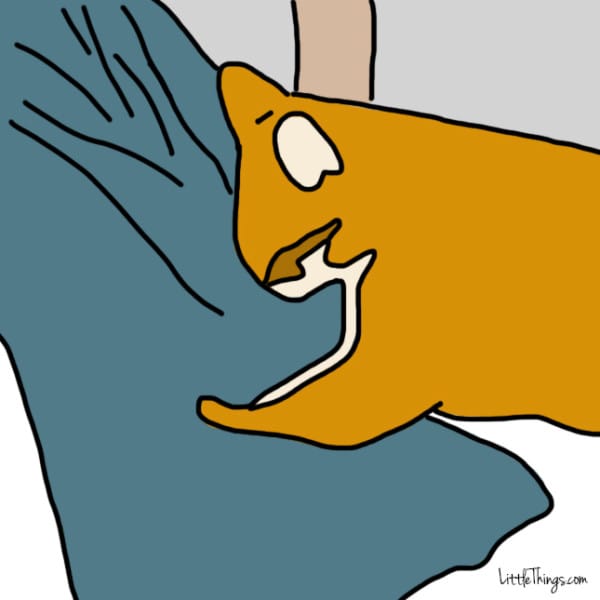
1. Kneading Your Legs
2015-12-03-1449157858-59423-Cat1.jpg

Kneading is when your cat uses their paws to push in and out against a soft surface, such 
as your lap. This is one of the main ways your cat tries to say “I love you.” According to 
PetMD“If your cat is curled up and kneading your lap while you’re petting him, he’s 
returning the affection and telling you he loves you right back. Unfortunately, this can 
be quite painful, since the happier he is, the harder he’ll dig in with his sharp nails.” They recommend that you ease the painful part of this kneading by “placing a thick, soft barrier between the cat and 
your lap.”

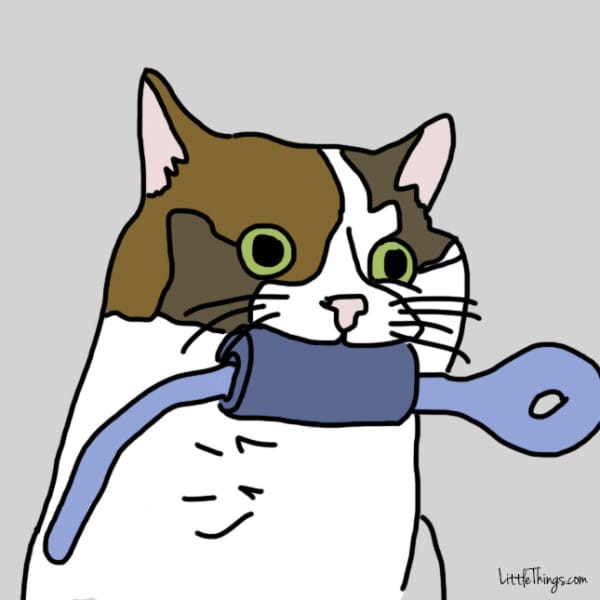
2. Bringing You a Present
2015-12-03-1449157882-1402211-Cat2.jpg

You may be familiar with your cat bringing you presents, such as toys or small, dead animals. 
This is your cat’s way of showing love. Certified Animal Behavior Consultant Amy Shojai
writes, “Cats love with gifting. Mighty hunter cats that catch everything from toys to bugs, 
mice or frogs, often share the bounty with those they love. Kitties who present you with this bounty deserve praise.” While it might seem odd, Shojai says, “They wouldn’t bring these 
special gifts if they didn’t love you.”

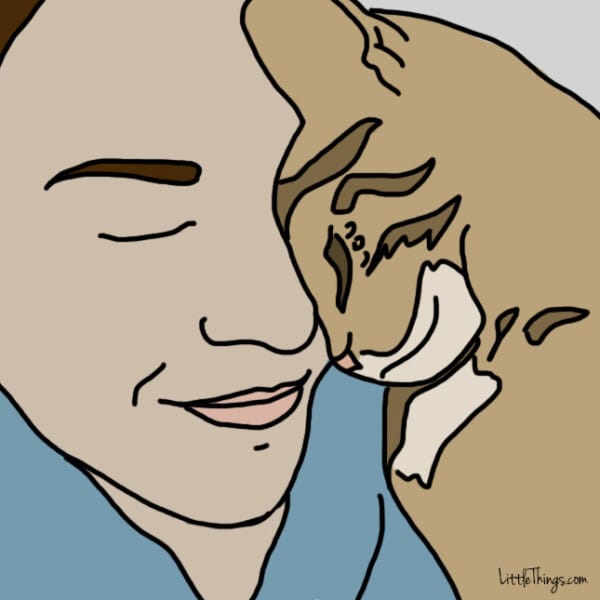
3. Head-Butting You

2015-12-03-1449157907-2257293-Cat3.jpg


Head-butting may seem like an odd behavior, but it actually shows that your cat truly cares
about you. According to Mother Nature Network, “Cats have secret glands concentrated on certain parts of their bodies, including their cheeks and heads. When your kitty rubs her
head or face against you, she’s marking you with her scent and claiming you as part of her
family group.”
They continue, “This scent is a source of both comfort and familiarity for your kitty.”

4. Staring Into Your Eyes

2015-12-03-1449157928-1369697-Cat4.jpg


Staring at you and slowly blinking is a way in which your cat shows you great affection.
Dr. Karen Becker writes, “This might be the display of cat love that is easiest for humans to understand. If your kitty first stares at you, then blinks, then opens his eyes wide, then slowly blinks a second time, he’s telling you he loves and trusts you.”
She says this is an extreme sign of affection. “It’s the equivalent of being kissed.”

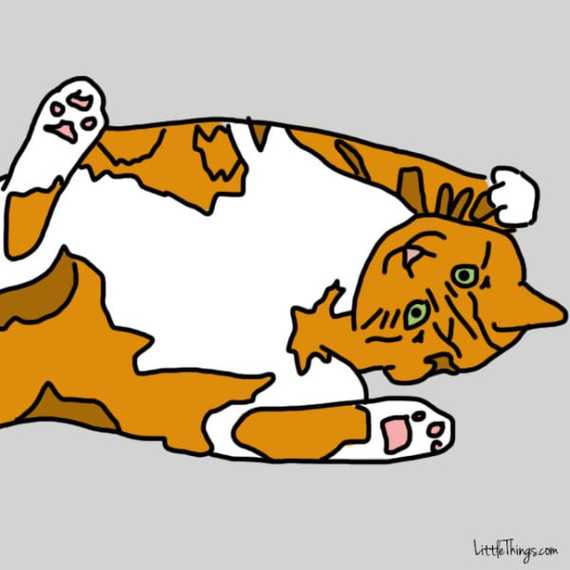
5. Showing You Their Belly
2015-12-03-1449157962-6630568-Cat5.jpg

The flashing of the stomach is one way that your cat is saying “I love you.”
According to IHeartCats.com, “Like most animals, cats do not show their stomachs to
just anyone. If your cat rolls over on its back to give you a flash of that fuzzy belly, this is
an indication that they feel comfortable around you.”
They continue, “Not only this, but they feel loved and protected by you, rendering
themselves defenseless while on their backs.”

6. Curving the Tip of Their Tail
2015-12-03-1449157978-2505760-Cat6.jpg

The tail can actually be an incredible barometer into how your cat feels about you.
In an essay entitled, Ask a Behaviorist: How Do Cats Show Affection to People?, Catster
writes, “Kitties express happiness and warm feelings by fluffing out the base of their tails
while subtly quivering them. Simultaneously, they hold their tails upright with a slight
curve at the top.”
They continue that this tail curve “is sometimes called the happy tail dance.”

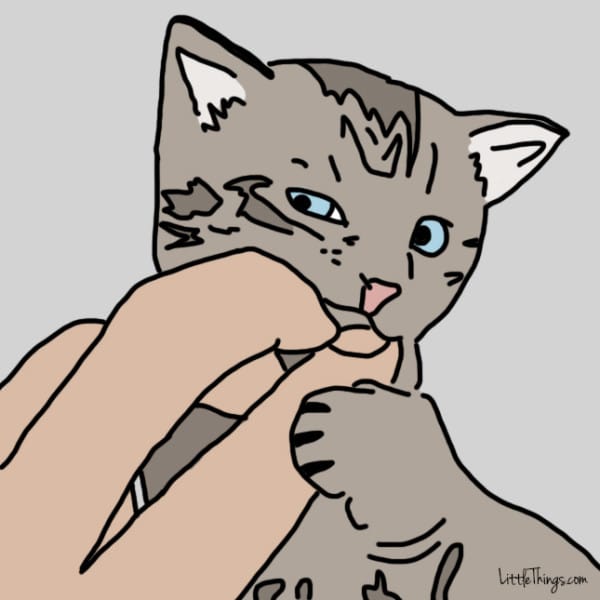
7. Nipping You
2015-12-03-1449157995-2071236-Cat7.jpg


Don’t get mad, because gently nipping at your finger is another way your cat is saying
that they love you.
According to Dr. Karen Becker, “This show of love from your kitty can prove to be a
bit painful... [but] your cat really doesn’t understand her love bite isn’t always
pleasant for you.”
These love bites can also be seen as your cat interacts with other cats. “Kitties nip
each other affectionately, and their skin is tougher than ours.”

8. Rubbing Against Your Legs
2015-12-03-1449158011-3305896-Cat8.jpg

When your cat just can’t seem to get enough of your legs, that is likely a sign of true love.
Dr. Karen Becker writes, “Rubbing against another creature is how cats show affection.
If your kitty rubs up against your leg... he’s putting his scent on you as a way of
claiming you as his own.” This is quite similar to the head-butting behavior.
“It’s important to your relationship and bond with your cat to allow him to rub
against you.”

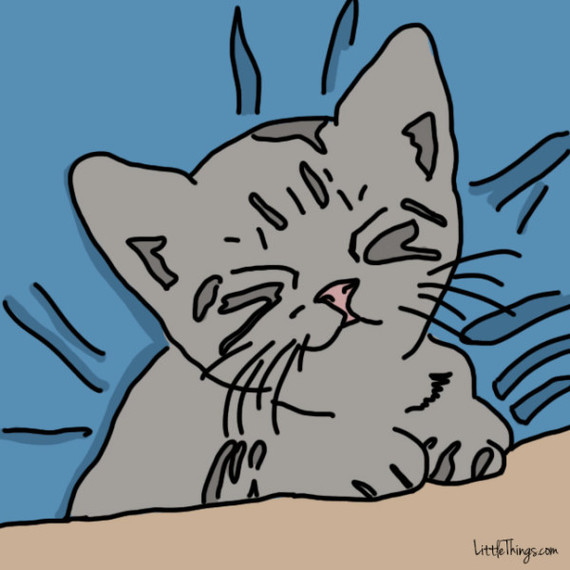
9. Purring
2015-12-03-1449158039-7294777-Cat9.jpg


You’ve heard your cat purr before, but you may not have realized that this was a love purr.
According to certified expert Amy Shojai, “Cats love with purrs. Her purrs can mean
a variety of things, from delight to expressions of concern. And kitty purrs range from
soft and subtle to Mack-truck loud.”
In case you had any doubt, she writes, “When your cat purrs in your presence, you
can be sure she’s expressing her love for you.”

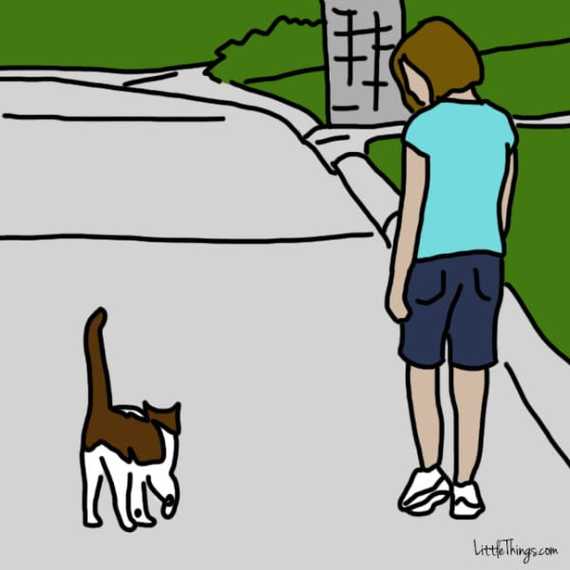
10. Following You Around
2015-12-03-1449158055-8981473-Cat10.jpg

If your cat can’t seem to get enough of your company, you know you have a loving connection.
According to the Mother Nature Network, “If your feline friend follows you from room
to room, jumps onto tables and counters to be near you, and always seems to be
right where you step, she clearly enjoys your company.”
A good test is if your cat continues to follow you, “especially if it’s not near feeding time.”
Paying attention to these common cat behaviors is the best way to be sure
that your pet truly does love you.
Source: Phil Mutz, writer at LittleThings.com

Hot for the summer

To avoid these problems and enjoy the  summer season  with your  pet , here're the tips to keep in mind. Provide plenty of water and...